Experience Seamless End-to-End AIS 2.0 Connectivity with Sternula
The Sternula AIS 2.0 Pilot Project offers a complete setup that combines Sternula’s advanced hardware with satellite and coast station connectivity. Built on VDES (VHF Data Exchange System) technology, AIS 2.0 enables the digitalization of vessels and coastal infrastructure. With AIS 2.0, maritime safety and efficiency are significantly enhanced. Navigational warnings (S-124) are updated and displayed in real time on an ECDIS, ensuring that ship operators always have access to the most current information.
Through the Maritime Connectivity Platform (MCP), Sternula’s MMS routers ensure fast, secure, and reliable data exchange from ship to shore, shore to ship, and ship to ship. This connectivity enables seamless communication and supports the growing demand for digital maritime services.
For maritime authorities, AIS 2.0 simplifies the digital transformation process. By relying on Sternula’s infrastructure, authorities can focus solely on providing S-100 services, while Sternula delivers the foundation that makes these services possible.
Timeline
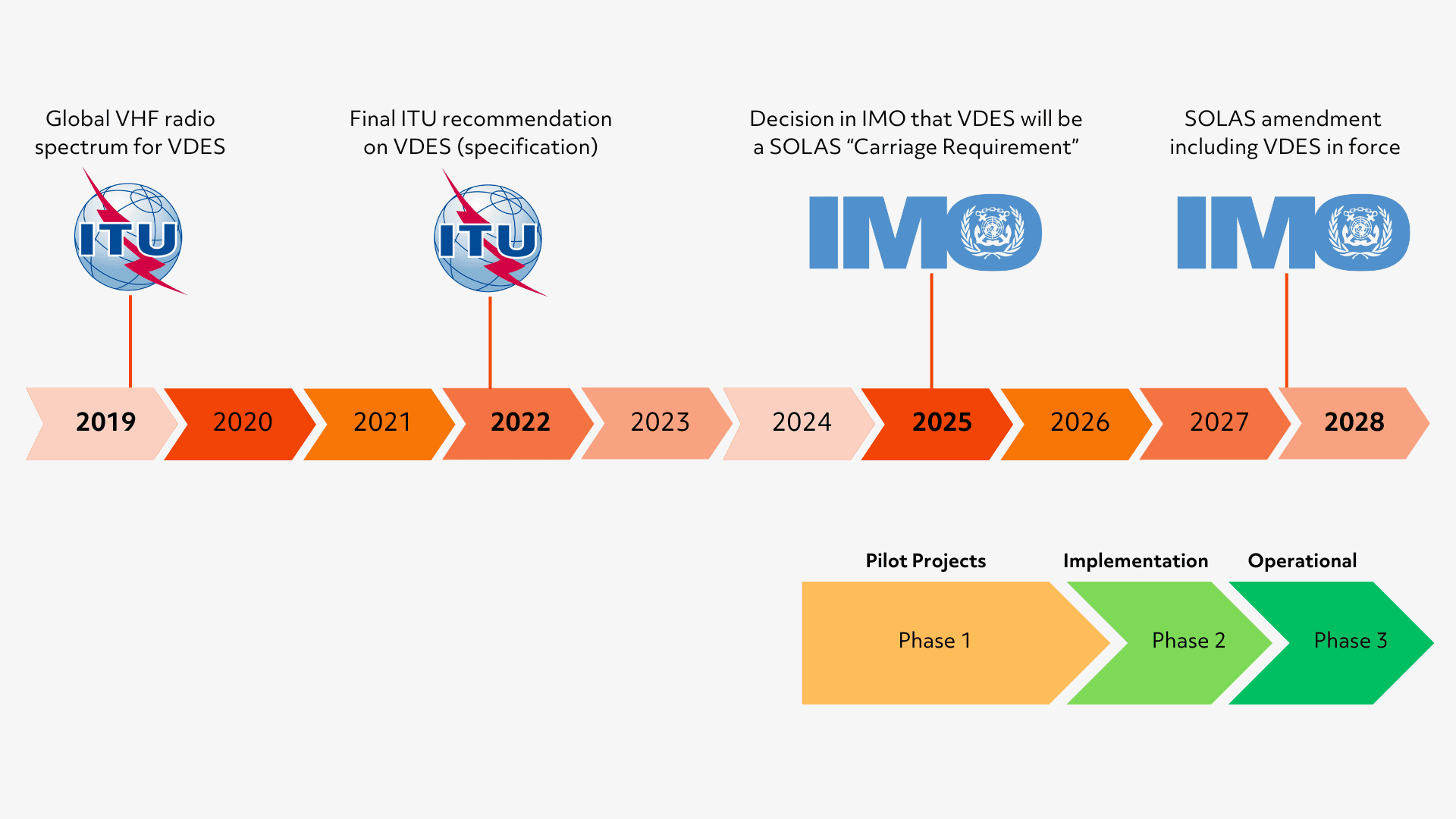
VDES follows a clear international regulatory roadmap from spectrum allocation to regulatory implementation under SOLAS Chapter V.
After the global VHF spectrum was allocated and the technical specification finalized by ITU, the next milestone is the IMO decision to make VDES a SOLAS carriage requirement, with the amendment expected to enter into force in 2028. To support this transition, implementation progresses in phases: beginning with pilot projects to build operational experience and define requirements, followed by structured implementation, and ultimately full operational status. Early engagement enables authorities to strengthen readiness and ensure a smooth transition ahead of regulatory enforcement.
Sternula is currently supporting pilot projects with maritime authorities to enable a structured and low-risk transition toward VDES, MCP/MMS and S-100–based services, in line with IALA guidance. Sternula’s AIS 2.0 Pilot Project ensures compliance with the carriage requirement of VDES, starting January 1st, 2028, on board all IMO vessels. These pilot initiatives allow authorities to gather operational experience and define technical requirements before larger-scale implementation.
A test of the AIS 2.0 setup will lead to:
An improvement in maritime safety and the potential for faster emergency response times.
Enhanced control over unauthorized maritime activities within the region.
Strengthening national sovereignty and situational awareness, promoting a more proactive and digitalized approach to maritime governance.
Available AIS 2.0 Pilot Projects
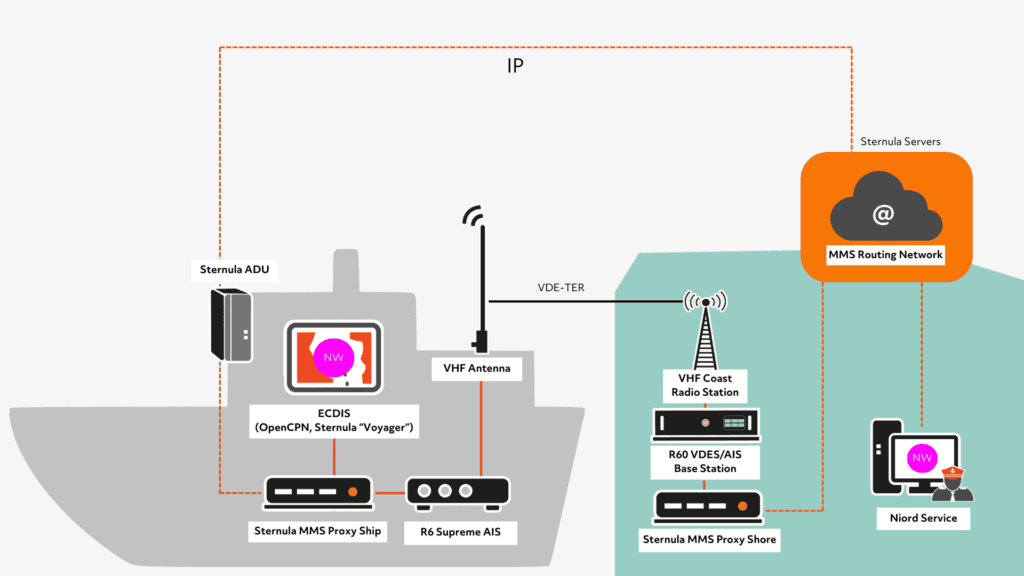
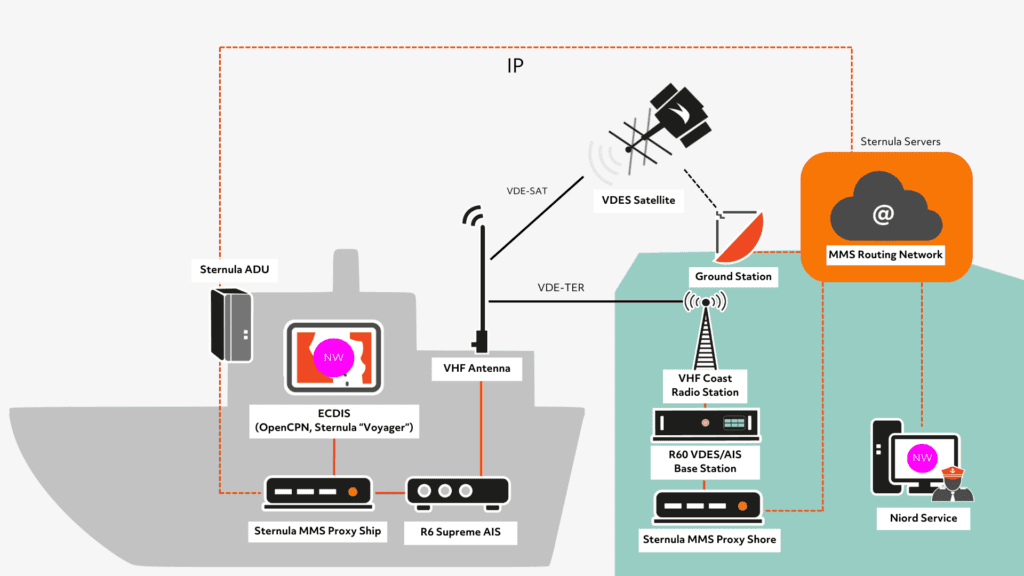
Our AIS 2.0 solution includes the possibility to transmit data via VDE-SAT, VDE-TER, or an IP-connection, and our MMS-based routing automatically selects the best connection at the time of transmission.
A key strength of Sternula’s technological approach is that the new components are fully compatible with existing AIS standards. Moreover, the system is fully functional even without satellite connectivity, allowing authorities to deploy and operate it in coastal areas or under budget constraints without compromising core functionality.
This means the solution can be introduced and scaled gradually, providing a seamless upgrade path to the new world of a Secure Digital Maritime Domain. It ensures continuity and resilience by enabling a smooth migration from legacy AIS systems toward next-generation secure digital communication, all while maintaining operational stability and minimizing financial risk.
All components of the VDE-TER Pilot Project, plus:
VDE-SAT Connectivity
AIS 2.0 Live Demonstration Outside Port of Copenhagen
During the MaDaMe project, a pilot test of our AIS 2.0 solution on four different ships, we successfully demonstrated reception of navigational warnings.
The video shows the process of using NIORD to publish an S-124 Navigational Warning on board one of our demo vessels, Poul Løwenørn. This was all done using the setup descripted and depicted above, from shore to ship using a VDE-TER connection.
The MaDaMe project is carried out to ensure the quality of our solution. The results solidify our confidence. Sternula’s AIS 2.0 VDES Implementation solution is ready.
Network of Networks - VDES & MMS
AIS 2.0 consists of two elements. Firstly, VDES, the key radio access technology enables significantly higher data rates than traditional AIS. Secondly, MMS, the network that routes data either by VDE-TER, VDE-SAT, or IP. By adding a digital signature, receivers can remain fully confident in the transmitted data, using MIR and MSR, integral components of the Maritime Connectivity Platform (MCP). To deliver a digital service, such as a S-124 (Navigational Warning), a Sternula MMS Proxy Shore sends and delivers the data to a Sternula MMS Proxy Ship, guiding any vessel out of harms way. This is just one of the many qualities our worldwide AIS 2.0 Implementation solution includes.
VDES enables the sending of digital data, where our MMS edge routers enables both ship and shore to receive it, thereby serving as the glue that binds everything together. Two-way communication in a way the maritime industry has never experienced before.
With our network of networks, Maritime authorities only focus on providing S-100 services, e.g. S-124 (Navigational Warnings), rather than the underlying infrastructure. Hardware and satellite connectivity, all provided through our service at Sternula. Our solution allows you to implement VDES according to IALA guideline G1117, ensuring compliance with the new IMO instruments around VDES.